Lawrence Hargraves
Lawrence Hargraves was born in England, 1850 the son of a judge. When he was fifteen Hargraves moved to Australia where his father became judge in the Supreme Court of Australia. He became interested at an early age at the possibility of powered flight. Hargraves refused to patent any of his inventions, instead preferring them to benefit anybody who wished to use them. Lawrence Hargraves made a very important contribution to aeronautics when he invented the cellular or box kite. Hargrave's experiments with kites were really took place in order to further his knowledge of powered flight.
Hargraves invented the box kite in 1893. He built a large number of model aeroplanes and kites during 1893. His experiments developed various forms of plane-surfaces, dihedrals (an angle formed by two plane surfaces) and box kites. Hargraves kept all his detailed notes of all the experiments that took place and even flew himself beneath a train of box kites to a height of 16ft.
Hargraves made a number of models during this period. The models were made from a variety of materials ranging from tin sheet to redwood and veneer. The models were a combination of both dihedral and cellular kites. These models helped Hargraves to invent the Box Kite.
Press on the following link to view six of the models. Hargraves Models.
Hargraves made a major contribution to the study of aerodynamics (the study of the effect that a solid body has on air, when travelling through it), when his experiments were influential in the development of the cambered aerofoil (a structure with curved surfaces which gives lift when in flight). The tailplane, wing and fin are examples of aerofoiles.
Hargraves used Horatio. F. Phillips findings in 1880 to help him increase the efficiency of his box kite. Phillips created the double-surfaced aerofoil. This type of aerofoil was capable of producing a lower pressure above the wing surface than below. The difference in pressures would certainly allow the wing to rise faster.
Hargraves gave up all experiments a year later after he repeatedly failed to create powered flight. The image below shows the Single-celled, reflex-curved aerofoil kite, designed by Hargraves.
The Royal Aeronautical Society has lent it to the Science museum.
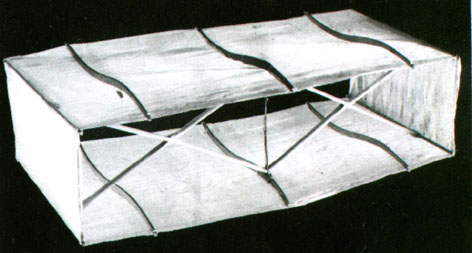
Press on the link to see the model of Hargrave's box kite aeroplane. It incorporates the single-celled, reflex-curved aerofoil kite.
Courtesy of The Royal Aeronautical Society.
The images below show two model, soaring kites of Hargraves, produced in 1893. His inspiration were the soaring wings of the albatross (a bird with the largest of wing spans).
Most of Hargraves models were destroyed in the Second World War when the Allies bombed the Munich Museum they were being displayed in. The famous Wright brothers later incorporated Hargraves ideas to improve the performance of their gliders after 1899. The Wright brothers were responsible for pushing the frontiers of powered flight. Many of Hargraves box kite ideas were later on incorporated into powered flight vehicles.The images are courtesy of the Royal Aeronautical Society.

The image below shows the final perfected version of the Hargraves box kite, 1893. The box kite could be folded easily for transportation. The spars (poles) were streamlined to reduce the wind resistance and the cords in the middle could be adjusted in order to gain maximum vertical and horizontal tension of all of the surfaces.
The kite was flown from a single line attached to the fulcrum or balance point below the kite. This point can be seen on the image below.
It was lent to the Science Museum, London by Sir Richard Threlfall.
